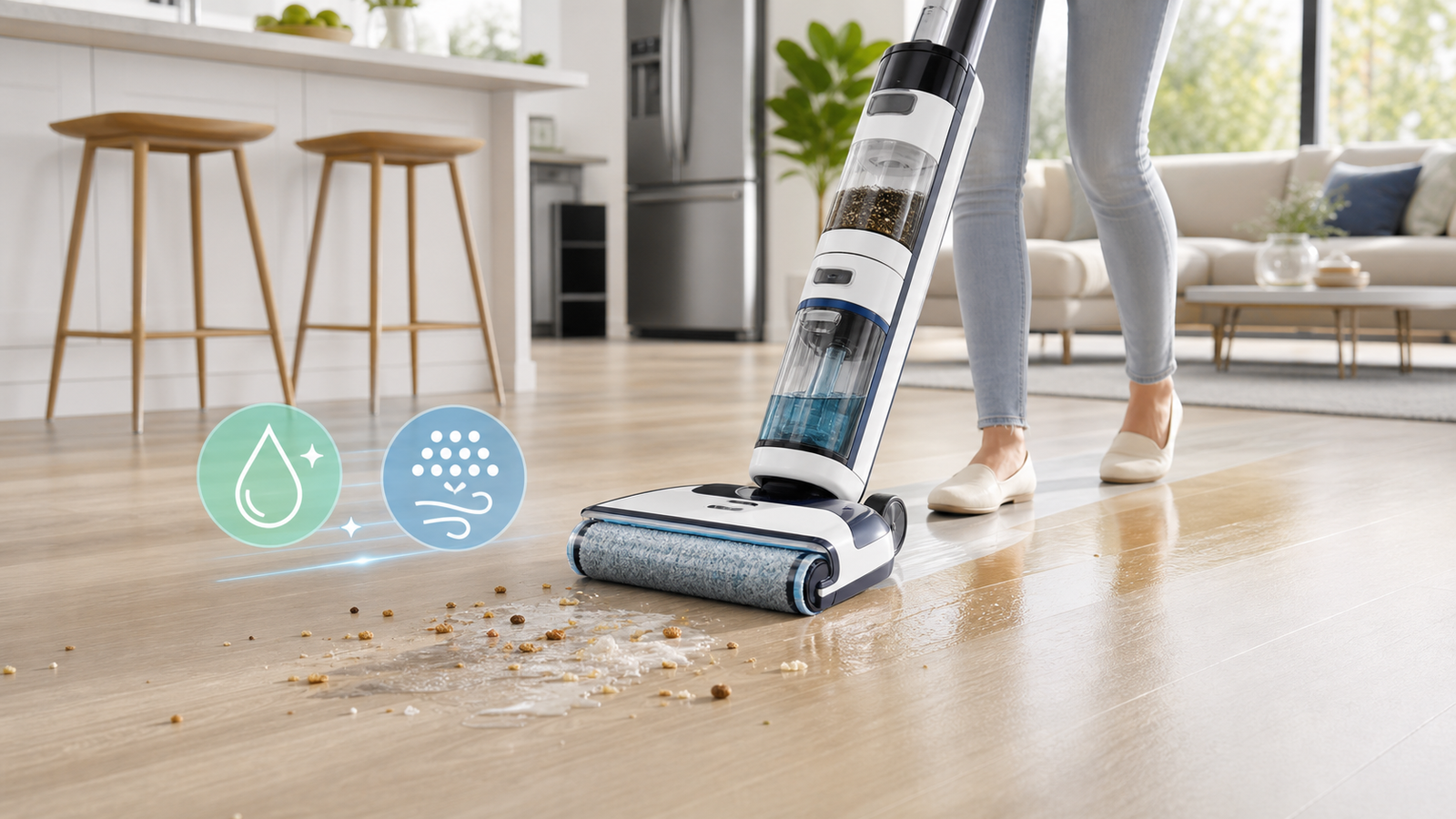
Quick Answer (TL;DR)
A Tineco vacuum mop is a cordless 2-in-1 floor washer that vacuums up dry debris and mops with fresh water at the same time, so you clean hard floors in a single pass. Its iLoop smart sensor auto-adjusts suction and water flow to how dirty the floor is, a dual-tank system keeps clean and dirty water separate, and a self-cleaning cycle rinses the roller for you. For most homes, the Floor One S5 is the best value; upgrade to the S7/S9 for longer runtime and better edge cleaning.
A Tineco vacuum mop is one of the easiest ways to skip the two-step "vacuum then mop" routine on hard floors. Instead of dragging out a vacuum and then a bucket, you push one cordless machine across the room and it lifts dry dirt and washes the floor in the same pass. This guide breaks down what it is, how it works, which model to buy, and how to keep it running clean - with practical tips from real-world use.
Think of it as a floor washer built for busy, messy, real-life homes: kids, pets, spilled coffee, muddy shoes. If that's your floor, keep reading.
What Is a Tineco Vacuum Mop?
A Tineco vacuum mop is a cordless wet-dry floor cleaner that vacuums and mops hard floors simultaneously. It's made by Tineco, a smart-home appliance brand known for its Floor One and iFloor lines of floor washers.
Unlike a traditional mop that just smears water around, this machine has a spinning microfiber roller that's constantly fed with clean water and solution, while the vacuum motor pulls the dirty water straight off the floor into a separate tank. So you're always cleaning with fresh water, not the muddy stuff.
In plain terms:
- It vacuums dry crumbs, hair, and debris.
- It mops with fresh water and cleaning solution.
- It sucks the dirty water back up so floors dry fast.
- It does all three at once.
Real-world example: A pet owner with hardwood floors can roll over a trail of kibble, dried paw prints, and a water-bowl spill in one pass - no sweeping first, no soggy floor after.
Is a Tineco a Vacuum or a Mop?
It's both - a Tineco is a 2-in-1 vacuum and mop in a single cordless unit. The vacuum and the mopping system run together, so there's no switching modes or attachments for everyday cleaning.
That said, it's designed for sealed hard floors (tile, sealed hardwood, laminate, vinyl/LVP, stone). It's not a carpet-deep-cleaner and not a replacement for a high-suction dry vacuum on thick rugs.
How Does a Tineco Vacuum Mop Work?
A Tineco vacuum mop works by combining a motorized cleaning roller, a dual water-tank system, and smart sensors into one pass. The roller scrubs while fresh water drips onto it, and suction immediately pulls the dirty water into a separate tank.
Here's what's happening under the hood:
- Clean water tank releases fresh water + solution onto the spinning roller.
- Roller scrubs the floor and loosens grime.
- Suction lifts the dirty water and debris off the floor instantly.
- Dirty water tank collects the gunk - kept fully separate from clean water.
- iLoop smart sensor reads how dirty the floor is and dials suction, water flow, and roller speed up or down automatically.
What Is the iLoop Smart Sensor?
The iLoop smart sensor is Tineco's dirt-detection technology that automatically adjusts suction power and water flow based on how messy the floor is. A ring on the display glows red when it senses dirt and turns blue when the spot is clean.
This matters for two reasons: you get more cleaning power exactly where you need it, and you save battery and water everywhere else. It also doubles as a handy "am I done?" signal - keep going until the ring turns blue.
What Does the Self-Cleaning Function Do?
The self-cleaning function flushes fresh water through the roller and inner tubing so you never have to touch a dirty roller by hand. You just dock the machine on its charging base and start the cycle.
Pro Tip
Empty and rinse the dirty-water tank after every use, even when you run self-cleaning. Standing dirty water is the #1 cause of that musty "wet dog" smell people complain about.
Which Tineco Vacuum Mop Should You Buy?
The best Tineco vacuum mop for most people is the Floor One S5 - it's the sweet spot of price, smart features, and runtime. Step up to the S7 or S9 for longer battery life and better edge cleaning, or drop to the iFloor line for a simpler, cheaper option.
Tineco's lineup can feel confusing because there are many models, so here's the honest breakdown:
| Model | Best for | Runtime | Standout feature | Smart sensor + LED? |
|---|---|---|---|---|
| iFloor 3 / iFloor 5 | Budget buyers, small homes | ~20-25 min | Lightweight, simple | No |
| Floor One S5 | Most homes (best value) | ~35 min | iLoop sensor, dual-tank | Yes |
| Floor One S6 Stretch | Cleaning under furniture | ~30-40 min | Lays completely flat | Yes |
| Floor One S7 Pro | Bigger homes, edges | ~40 min | Dual-sided edge cleaning, self-propulsion | Yes |
| Floor One S7 Steam | Extra sanitizing | ~40 min | Steam mopping modes | Yes |
| Floor One S9 Artist Pro | Premium, large homes | ~75 min | Longest runtime, 1L clean tank | Yes |
Runtime and spec figures are drawn from Tineco's published product pages and retailer listings; confirm current specs on the official Tineco site before publishing, as models update frequently.
iFloor vs. Floor One: What's the Difference?
The main difference is smarts and convenience: the Floor One line adds the iLoop smart sensor, an LED display, and stronger self-cleaning, while the iFloor line is a simpler, lighter, cheaper wet-dry mop without auto-adjusting sensors.
Choose based on this:
- Pick iFloor if you want the lowest price and a lightweight machine for a small space.
- Pick Floor One if you want the smart sensor to do the thinking and you clean larger or messier floors.
My Take: The One Upgrade Actually Worth Paying For
Here's an opinion you won't find in most spec-sheet roundups: runtime and tank size matter more than the model number. People obsess over which "S" they're buying, but the real day-to-day frustration is running out of battery or clean water mid-room and having to stop, refill, and re-dock.
If your home is over ~1,000 sq ft or you clean multiple rooms in one go, the longer-runtime, bigger-tank models (S7/S9) pay for themselves in avoided interruptions. For a small apartment, the S5 will never feel limiting - don't overspend.
How Do You Use a Tineco Vacuum Mop? (Step by Step)
To use a Tineco vacuum mop, fill the clean water tank, power it on, and push it slowly across sealed hard floors while the machine vacuums and mops at once. Then run the self-cleaning cycle on the dock.
- Fill the clean water tank with cool water and the recommended amount of Tineco cleaning solution.
- Pick up large debris first - the machine handles crumbs and hair, but not big chunks or lots of standing liquid.
- Power on and let the iLoop sensor set the cleaning level (Auto mode is fine for most floors).
- Push forward slowly, then pull back over the same line - the backward pass is where it dries the floor.
- Watch the sensor ring: red means keep going, blue means clean.
- Hit Max mode for sticky or dried-on messes.
- Dock and run self-cleaning when you finish.
- Empty and rinse the dirty-water tank and pull out the roller to air-dry.
Common Mistake
Overfilling with solution. Too much cleaning liquid leaves a sticky film and more streaks, not cleaner floors. Follow the fill line.
Can You Use a Tineco on Hardwood Floors?
Yes - you can use a Tineco vacuum mop on sealed hardwood floors, and it's one of its best use cases because it leaves only a light film of water that dries in about a minute. The key word is sealed.
Avoid it on unsealed, waxed, or oiled wood, where any water can cause damage. On sealed hardwood, use the Auto or a lower water setting rather than blasting Max mode everywhere.
Common Tineco Vacuum Mop Mistakes to Avoid
The most common Tineco mistakes are skipping the self-clean cycle, leaving dirty water in the tank, and using it on the wrong surfaces. Each one shortens the machine's life or leaves floors worse than before.
- Leaving dirty water sitting - musty smell and bacteria. Empty after every use.
- Never removing the roller to dry - mildew. Take it out and let it air-dry.
- Using hot water - can damage components. Use cool or lukewarm.
- Cleaning up big liquid spills - overwhelms the dirty tank. Blot large spills first.
- Running it on carpet or unsealed wood - poor results or damage. Stick to sealed hard floors.
- Ignoring filter maintenance - weak suction. Rinse and fully dry the filter regularly.
Tineco Vacuum Mop vs. Traditional Mop and Vacuum
A Tineco vacuum mop beats the traditional mop-and-bucket combo on speed, hygiene, and effort because it uses fresh water on every pass and dries floors as it goes. A regular mop spreads increasingly dirty water around.
| Factor | Tineco Vacuum Mop | Mop + Bucket + Vacuum |
|---|---|---|
| Steps | One pass, one device | Two devices, two chores |
| Water | Always fresh (dual-tank) | Gets dirtier as you go |
| Dry time | ~1 minute | Often 10+ minutes |
| Effort | Low (self-propelled models) | High |
| Upfront cost | Higher | Lower |
| Maintenance | Rinse tank + roller | Wring and store mop |
Key Takeaways
- A Tineco vacuum mop vacuums and mops sealed hard floors in a single cordless pass.
- The iLoop smart sensor auto-adjusts suction and water flow, and signals red (dirty) or blue (clean).
- A dual-tank system keeps clean and dirty water separate, so you never mop with dirty water.
- The Floor One S5 is the best value pick; S7/S9 add longer runtime and better edges; iFloor is the budget option.
- Runtime and tank size affect daily experience more than the model number.
- Only use it on sealed hard floors - never unsealed wood or carpet.
- Empty the dirty tank and air-dry the roller after every use to avoid odor.
FAQ: Tineco Vacuum Mop
A Tineco vacuum mop is used to vacuum and mop sealed hard floors at the same time. It handles everyday messes like crumbs, pet hair, spills, and sticky spots on tile, laminate, vinyl, and sealed hardwood.
Yes, it's well suited for pet hair because the roller and suction pick up hair while washing the floor in one pass. Rinse the dirty-water tank and roller after each use, since pet hair can tangle and hold odor.
You should empty and rinse the dirty-water tank after every use and run the self-cleaning cycle each time you finish. Deep-clean the roller and filter every week or two, depending on how often you use it.
A Tineco vacuum mop is built for hard floors, not deep carpet cleaning. Some models can freshen low-pile rugs lightly, but you shouldn't rely on it as your main carpet cleaner.
The Floor One S5 is the best choice for most homes thanks to its balance of smart features, runtime, and price. Choose the S7 or S9 for larger homes that need longer battery life and better edge cleaning.
A Tineco usually smells because dirty water or a damp roller was left inside after cleaning. Empty the tank, remove and air-dry the roller, and run a self-clean cycle with a little cleaning solution to fix it.