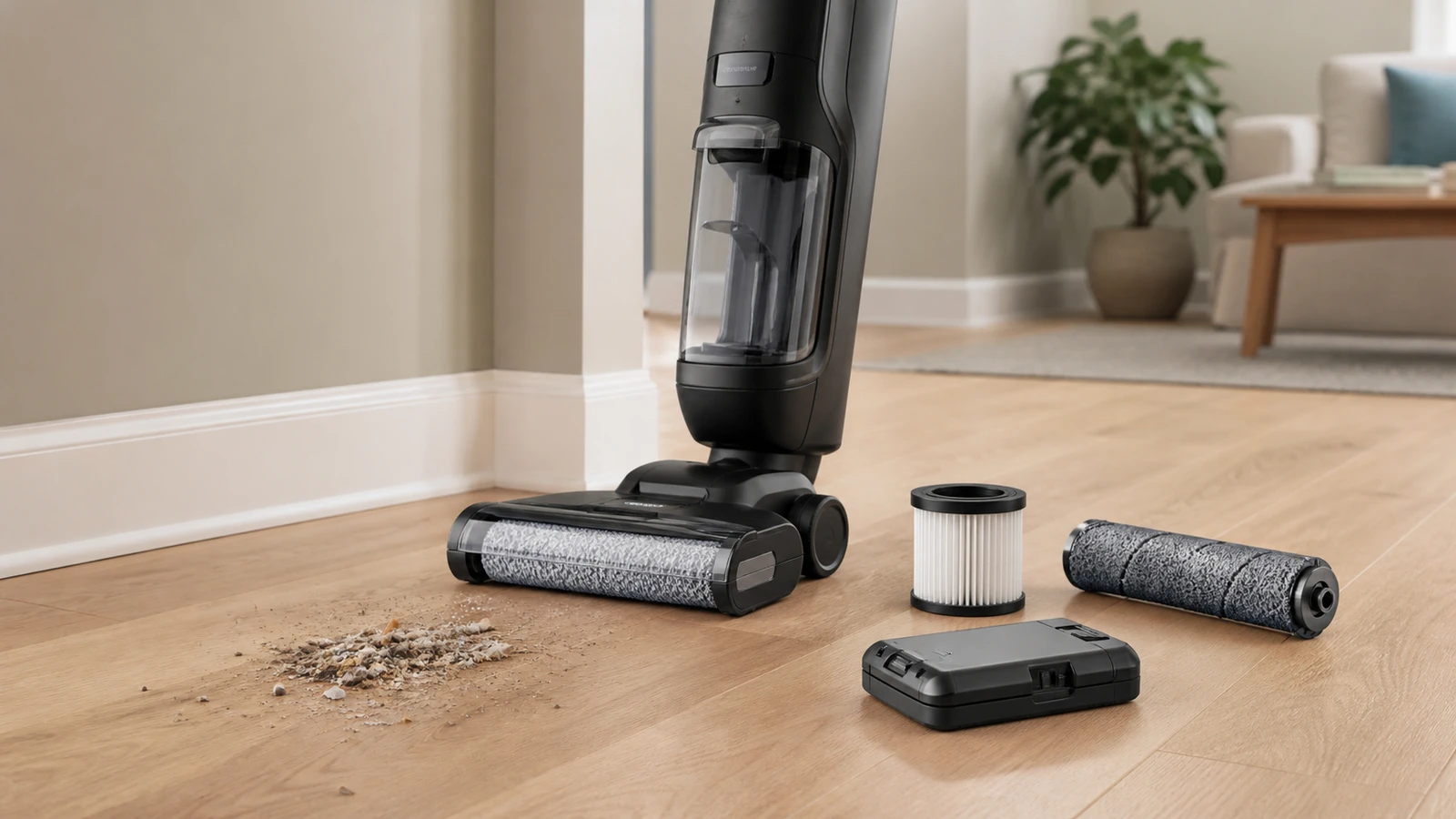
If you're asking "why does my Tineco keep shutting off," the short answer is that your Tineco isn't broken — it's protecting itself. Tineco cordless vacuums and wet-dry floor washers use automatic shutoff as a safety feature. When airflow is blocked, the brush roller stalls, a tank isn't seated, or the battery gets too hot or too low, the machine cuts power instead of burning out the motor.
That's good news. Most shutoff problems are fixable in under 15 minutes with no tools and no service ticket.
Quick Answer (TL;DR)
Your Tineco keeps shutting off most often because of a clogged filter or airflow path, a jammed brush roller, a full or improperly seated dirty-water tank, or thermal/low-battery protection. Clean the filter and roller, empty and re-seat both tanks until they click, let the unit cool for 30 minutes, then charge to full. If it still cuts out after 3–5 seconds of use with a clean, cool machine and full charge, the battery pack or a sensor is failing and needs service.
What does it mean when a Tineco shuts off by itself?
When a Tineco shuts off by itself, it has triggered a built-in protection circuit. These machines constantly monitor motor load, internal temperature, battery voltage, and (on wet-dry models) tank position and water level. If any reading goes out of range, the controller kills power.
So a self-shutoff is a symptom, not a fault. Your job is to work out which sensor is complaining.
Key terms, defined:
- Tineco — a floor-care brand best known for cordless stick vacuums (Pure One series) and wet-dry smart floor washers (Floor One / iFloor series).
- Thermal protection — automatic shutoff when the motor or battery exceeds a safe operating temperature.
- Overcurrent protection — shutoff when the brush roller or motor draws too much power, usually because something is wrapped around it.
- iLoop sensor — the dirt-detection sensor on Floor One models that adjusts suction and water flow based on how dirty the floor is.
Why does my Tineco keep shutting off? The 8 most likely causes
Your Tineco keeps shutting off for one of eight reasons, listed here from most to least common based on typical owner reports and manufacturer troubleshooting guidance .
| # | Cause | Telltale sign | Typical fix time |
|---|---|---|---|
| 1 | Clogged filter | Weak suction, high-pitched motor whine before cutoff | 5 min + dry time |
| 2 | Jammed brush roller | Roller stops spinning, burnt-hair smell | 10 min |
| 3 | Full / unseated dirty-water tank | Cuts off after a few seconds every time | 2 min |
| 4 | Blocked airflow or suction path | Sudden loss of pickup, rattling | 10 min |
| 5 | Thermal protection (overheating) | Runs 2–10 min, then dies; unit feels hot | 30 min cooldown |
| 6 | Low or aging battery | Runtime dropped well below spec | Charge or replace |
| 7 | Dirty charging or battery contacts | Won't hold charge, intermittent power | 5 min |
| 8 | Sensor, firmware, or board fault | Error lights, shutoff even when clean | Service |
1. A clogged filter is choking the motor
A clogged filter is the single most common reason a Tineco keeps shutting off. When the filter is packed with fine dust or still damp from washing, airflow drops, the motor works harder, heat builds, and thermal protection trips.
Fix it:
- Remove the filter and dustbin (or the dirty-water tank on wet-dry models).
- Tap out loose debris, then rinse the filter in cool water only — no soap, no scrubbing.
- Air-dry for a full 24 hours before reinstalling.
Real-world tip:
Owners who use their Tineco daily often reinstall a filter that's only "mostly dry." A damp filter behaves exactly like a clogged one. Buy a second filter and rotate them — it's the cheapest fix for repeat shutoffs.
2. The brush roller is jammed with hair or fibers
A jammed brush roller triggers overcurrent shutoff, usually within seconds of pressing the trigger. Long hair, pet fur, carpet threads, and mop-string fibers wrap around the roller ends and bind it against the housing.
Fix it:
- Pop out the roller (most Tineco rollers release with a single tab or clip).
- Cut away wrapped hair with scissors, working outward from the end caps.
- Check the roller bearings and end caps too — that's where fibers hide.
- Rinse a wet-dry roller, squeeze it out, and dry it fully before reinstalling.
Mini scenario
A Floor One owner with two shedding dogs reported the unit dying after 5 seconds. The roller looked clean from the top — but a tight ring of fur had wound behind the right end cap. Two minutes with scissors and it ran a full cycle again.
3. The dirty-water tank is full or not seated correctly
On wet-dry models like the Floor One and iFloor, a full or misaligned dirty-water tank causes an immediate shutoff. A float switch detects the high water level, and a position sensor confirms the tank is locked in place. Fail either check and the machine won't run.
Fix it:
- Empty the dirty-water tank — don't wait for it to look full.
- Rinse the tank, its lid, and the float assembly.
- Re-seat the tank until you hear or feel a positive click.
- Confirm the clean-water tank is also seated and filled.
A warped or debris-blocked tank gasket is a sneaky repeat offender. Wipe the seal every few uses.
4. Something is blocking the airflow path
An obstruction anywhere between the floor head and the dustbin creates the same backpressure as a clogged filter, and the motor shuts down to protect itself. Common blockage points are the floor-head inlet, the wand joint, and the elbow where the wand meets the body.
Fix it:
- Detach the wand and floor head, then look through each section toward a light.
- Clear debris with a broom handle or a plastic-bristle bottle brush.
- On wet-dry models, check the squeegee slot — dried gunk there restricts suction badly.
5. Overheating is tripping thermal protection
If your Tineco runs for a few minutes and then shuts off, and the body feels warm near the motor or battery, you're hitting thermal protection. Heat comes from restricted airflow, a stalling roller, heavy continuous use on max power, or a hot ambient room.
Fix it:
- Power off and let it rest 30 minutes in a cool room.
- Clean the filter and roller before restarting — heat is usually a downstream symptom.
- Use max/boost mode in short bursts rather than for whole rooms.
- Never charge immediately after a long hot run; let the pack cool first.
6. The battery is low, cold, or simply worn out
A weak battery causes clean shutoffs with no warning, and it's the most likely cause once the machine passes two to three years of regular use. Lithium-ion packs typically retain roughly 80% of original capacity after a few hundred full charge cycles, and voltage sag under load makes the controller read "empty" long before the pack is truly flat .
Signs it's the battery:
- Runtime is a fraction of the rated figure, even in eco mode.
- The unit dies instantly at maximum suction but runs on low.
- Charge indicators jump around or reach "full" unusually fast.
- It cuts out in a cold garage but works fine indoors.
Fix it: Charge to full uninterrupted, then run one normal cycle. If runtime is still poor, order a genuine replacement pack for your exact model. Avoid unbranded third-party cells — mismatched packs are a real fire risk.
7. Dirty or loose charging and battery contacts
Corroded or dusty contacts cause intermittent power, so the machine reads a phantom low battery and shuts off. This shows up most on wet-dry models, where humidity reaches the dock and contact pins.
Fix it:
- Unplug the charger.
- Wipe the contacts on the dock, the base, and the battery with a dry microfiber cloth or a cotton swab lightly dampened with isopropyl alcohol.
- Let everything dry fully, then reseat the battery firmly.
- Plug the charger into a wall outlet directly — skip power strips and extension cords.
8. A sensor, firmware, or control-board fault
If the machine is clean, cool, fully charged, and still shuts off, the problem is electronic. Suspect the iLoop dirt sensor, a water-level sensor, a stuck trigger switch, or the control board.
Fix it:
- Perform a reset: power off, remove the battery if removable, wait 30 seconds, reinstall, then charge to full.
- Update firmware in the Tineco app if your model supports it.
- Clean the sensor window (Floor One models) with a dry cloth — a smeared sensor sends false readings.
- If it persists, contact Tineco support with your serial number and purchase date.
How do I fix a Tineco that keeps turning off? A 10-minute diagnostic
Follow this order to fix a Tineco that keeps turning off — it moves from most to least likely cause and avoids wasted work.
- Empty everything. Dustbin or dirty-water tank, right down to the seal.
- Pull and inspect the filter. Rinse if dirty; dry 24 hours. Swap in a spare if you have one.
- Remove and de-hair the brush roller. Check the end caps and bearings.
- Sight-check the airflow path. Floor head, wand, elbow, squeegee slot.
- Re-seat both tanks until they click. Confirm the clean-water tank has water.
- Wipe the charging and battery contacts with a dry cloth.
- Cool down 30 minutes, then charge to 100% without interruption.
- Test on eco/low mode on hard floor for two minutes.
- Test on max mode. If it dies only here, suspect the battery.
- Still failing? Reset, update firmware, then contact support.
Original insight most articles miss:
Everyone blames the battery first. In practice, wet-dry Tineco models shut off far more often because of a tank-seating or water-level sensor issue than because of battery wear — and dry stick models shut off far more often because of a damp filter than anything else. Sort your troubleshooting by machine type, not by the loudest theory online. It saves most people an unnecessary battery purchase.
What do Tineco error lights and beeps mean?
Tineco uses light patterns and beeps to identify the shutoff cause, so the indicator ring is your fastest diagnostic tool. Patterns vary by model, so confirm against your manual, but the general logic holds:
| Indicator behavior | Usual meaning | First action |
|---|---|---|
| Flashing red, immediate cutoff | Brush roller blocked / overcurrent | Clear the roller |
| Slow red pulse | Low battery | Charge to full |
| Solid or rapid red with heat | Thermal protection | Cool 30 min, clean filter |
| Repeating beep on trigger pull | Dirty-water tank full or unseated | Empty and re-seat tank |
| Flashing after self-clean | Clean-water tank empty | Refill and reseat |
| Blinking with no other symptom | Sensor or board fault | Reset, then contact support |
Common mistakes that make Tineco shutoffs worse
These five habits cause most repeat shutoffs, and all of them are easy to stop.
- Reinstalling a damp filter. It mimics a clog and drives overheating. Dry it 24 hours.
- Washing the filter with soap. Detergent residue stiffens the media and cuts airflow.
- Running max power continuously. Use boost in bursts on high-traffic areas only.
- Skipping the self-clean cycle on wet-dry models. Residue hardens in the roller channel and squeegee slot.
- Storing the unit at 0% charge for weeks. Deep discharge accelerates capacity loss. Store around 40–60% if you'll be away.
When should you repair, replace the battery, or claim warranty?
Repair or replace based on the machine's age and which test it fails. Use this quick decision guide.
| Situation | Best move |
|---|---|
| Under warranty, shuts off after full cleaning | Open a warranty claim before opening the machine |
| 1–3 years old, dies only on max power | Replace the battery pack |
| 3+ years old, short runtime everywhere | Replace the battery, or replace the unit if parts are scarce |
| Error lights persist on a clean, charged unit | Service the sensor or control board |
| Physical damage or water in the electronics | Stop using it and contact support |
Keep your model number, serial number, and dated receipt together. Tineco warranty terms vary by region and retailer, so verify coverage on the official support site before you buy parts.
Key Takeaways
- A Tineco that keeps shutting off is usually protecting itself, not failing — the shutoff is a symptom, not the fault.
- Clogged or damp filters and hair-jammed brush rollers cause the majority of shutoffs on dry stick models.
- On wet-dry Floor One and iFloor models, a full or unseated dirty-water tank is the number-one culprit.
- Overheating shutoffs are almost always downstream of a clog — cool for 30 minutes, then clean the filter and roller.
- Battery wear is real but over-diagnosed; suspect it when the unit dies on max power but runs on eco.
- Dirty charging contacts create phantom low-battery shutoffs and take five minutes to fix.
- If a clean, cool, fully charged Tineco still shuts off, reset it, update firmware, then contact Tineco support with your serial number.
Frequently Asked Questions
Why does my Tineco shut off after a few seconds?
A Tineco that shuts off after a few seconds almost always has a jammed brush roller or an unseated dirty-water tank. Both trigger instant protection shutoff. Clear hair from the roller, empty the tank, and re-seat it until it clicks.
Why does my Tineco vacuum keep stopping when the battery is full?
If your Tineco stops with a full battery, the cause is airflow or load — not charge. A clogged filter, blocked wand, or bound roller makes the motor overdraw and shut down. Clean the filter and airflow path, then retest on low power.
How do I reset my Tineco vacuum?
To reset a Tineco, power it off, remove the battery if it's removable, wait about 30 seconds, then reinstall it and charge to 100% without interruption. This clears most protection-mode lockouts. If lights still flash after the reset, the issue is a sensor or board fault.
Can overheating make my Tineco turn off by itself?
Yes. Tineco vacuums include thermal protection that cuts power when the motor or battery gets too hot. Let the unit rest 30 minutes in a cool room, then clean the filter and roller, since restricted airflow is the usual reason it overheated.
How long should a Tineco battery last before it needs replacing?
Most Tineco batteries deliver several hundred full charge cycles — roughly two to four years of regular home use — before capacity drops noticeably. Replace the pack when runtime falls well below spec or the unit dies instantly on max suction. Always use a genuine pack for your exact model.
Is it bad if my Tineco keeps shutting off?
No — the shutoff itself is a safety feature protecting the motor and battery. But repeatedly triggering it means something stays blocked or overheated, and that shortens component life. Diagnose the cause instead of restarting the machine over and over.